A pet odor removal service inspection should identify the affected materials, map suspected contamination, check how far it extends, and review previous treatments before recommending cleaning. In 2026, ask for an explanation of what treatment can reach, what remains uncertain, and whether carpet backing, padding, upholstery filling, or another hidden layer needs attention.
- A pet odor removal service should inspect contamination depth, material suitability, and previous treatments before recommending cleaning.
- Steamly Pro serves homeowners seeking carpet, upholstery, tile and area rug cleaning across its Florida service area.
- Pet urine treatment and carpet cleaning need different expectations when contamination extends beneath the visible surface.
- Ask the estimate to separate accessible cleaning from hidden contamination and explain realistic odor outcomes.
Pet odor removal service: what should an inspection include?
A useful inspection connects the odor source to a material-specific treatment plan—not just a list of stained spots. You should understand which areas need attention, how the technician reached that conclusion, and which parts of the problem remain inaccessible or unconfirmed.
For homeowners in Boynton Beach, Boca Raton and Delray Beach, Steamly Pro offers carpet, tile and grout, upholstery, and area rug cleaning. Its service area includes Palm Beach County, Broward County and Port St. Lucie. Describe the affected material and odor history when requesting a free estimate so the conversation starts with the problem rather than an assumed cleaning method.
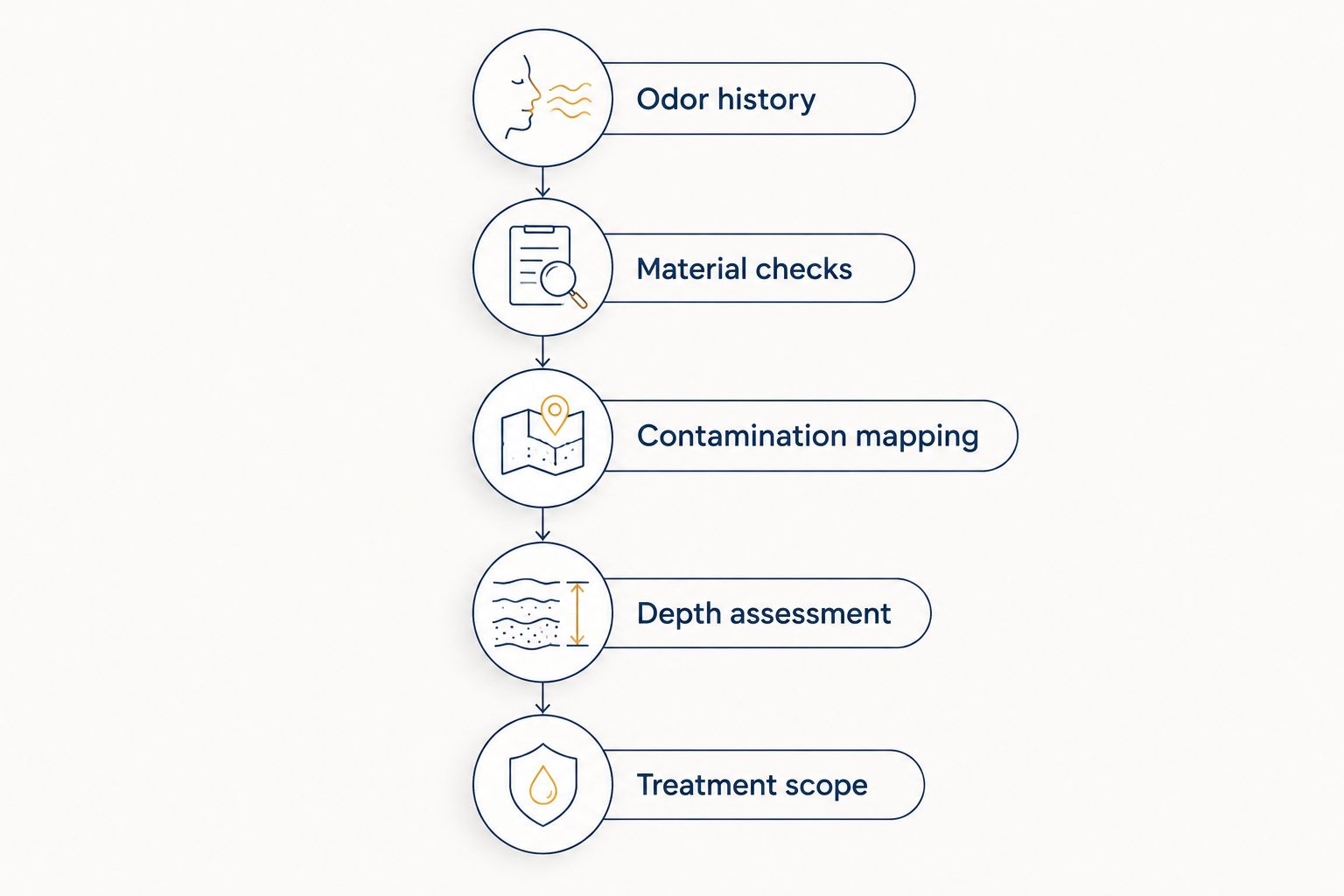
An inspection should cover the following sequence:
- Odor history: Where accidents happened, whether they repeated, and when the smell becomes noticeable.
- Material checks: Fiber, construction, backing, finishes and any care instructions that affect treatment.
- Contamination mapping: Visible marks, suspected odor sources and nearby areas that need investigation.
- Depth assessment: Whether the concern appears confined to the surface or involves underlying layers.
- Treatment scope: What cleaning addresses, what needs separate attention and how results will be assessed.
These checks establish the basis for a recommendation. They do not prove that every contaminated layer is accessible or that every odor can be removed.
Why this matters
An odor problem is not necessarily a surface-cleaning problem. Urine can move beyond the visible mark into carpet backing, padding, cushion filling or gaps between materials. Cleaning the exposed surface does not establish that those hidden areas received treatment.
The reverse matters too: an old stain does not automatically identify the current odor source. A technician needs to distinguish discoloration, residue and active odor before choosing treatment. Otherwise, you risk addressing the most obvious mark while overlooking the area that actually needs attention.
Judge the inspection by the explanation you receive, not by how confidently someone promises a result. A useful explanation names the material, the suspected source and the limits of access.
Odor history: explain what happened before cleaning
Tell the technician where your pet spends time, where accidents occurred and whether the same location was affected repeatedly. Include furniture edges, corners, doorways and the underside of removable rugs when those areas are relevant. An approximate location is useful; presenting an uncertain guess as a confirmed source is not.
Describe the timing of the odor. Does it appear after the room has been closed, after damp cleaning, or near a particular cushion? Those observations help direct inspection, but timing alone does not establish the cause.
Previous treatments belong in this conversation. Name any spot cleaner, deodorizer or disinfectant you used, and show the packaging if you still have it. Fragrances can complicate odor assessment, while residues and previous chemical exposure can affect the next treatment choice.
Do not apply another product immediately before the inspection to make the room smell better. You want the technician to assess the existing problem, not a fresh layer of fragrance.
Material checks: carpet, rugs, upholstery and grout differ
A 2026 inspection checklist should separate the surface you can see from the construction beneath it. Similar-looking materials can require different cleaning decisions, and a method suitable for one surface is not automatically suitable for another.
| Affected material | Best inspection focus | What accessible cleaning addresses | Important limitation |
|---|---|---|---|
| Wall-to-wall carpet | Best for checking backing and padding concerns | Soil and residues in the accessible carpet | Underlying contamination can remain outside the treatment scope |
| Area rug | Best for checking both faces and construction | Accessible fibers and compatible backing | Dyes, backing and construction can restrict treatment |
| Upholstery | Best for separating fabric from cushion filling | Accessible fabric and approved components | Internal filling is not automatically reached by surface cleaning |
| Tile and grout | Best for checking joints, edges and adjacent materials | Accessible surface soil and residue | Cracks, gaps and concealed layers need separate assessment |
The table is not a treatment prescription. Each surface needs its own inspection, especially when an odor crosses a room containing carpet, furniture and a rug.
What should the technician check on carpet?
Carpet inspection should consider fiber suitability, visible condition, previous spot treatment and evidence of repeated contamination. The technician should explain whether backing or padding is a concern and whether those layers can be assessed without additional access.
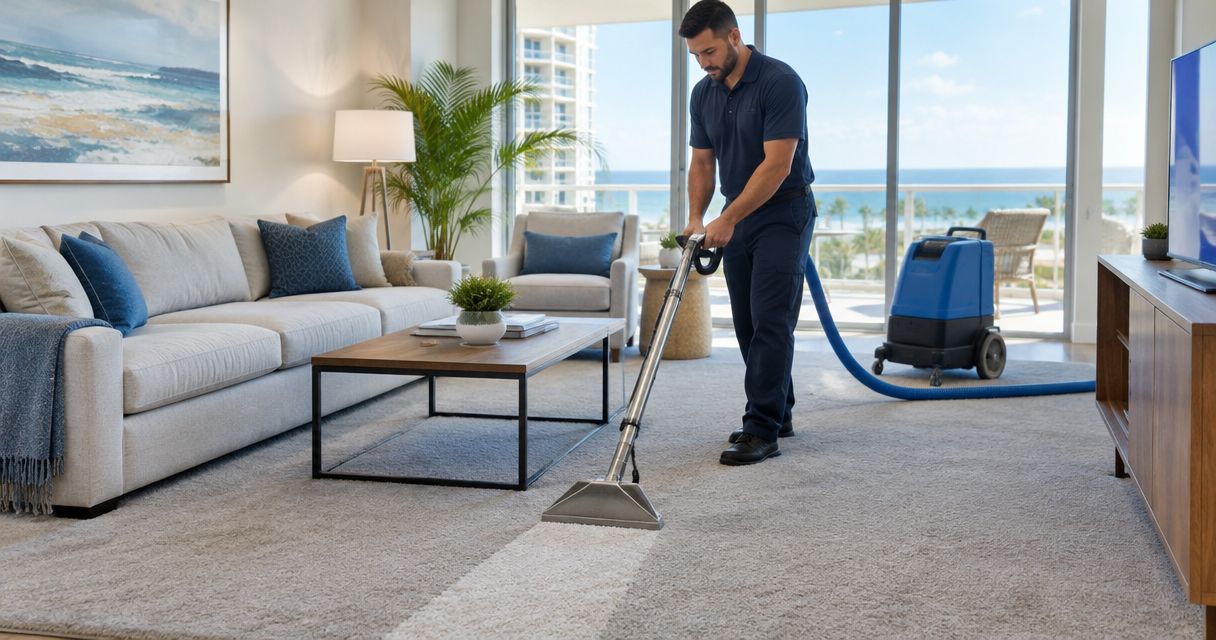
Hot-water extraction removes suspended soil and cleaning solution from accessible carpet. It is not proof that every underlying layer has been treated. Ask whether the proposed work addresses general carpet soil, pet contamination, or both.
What should the technician check on an area rug?
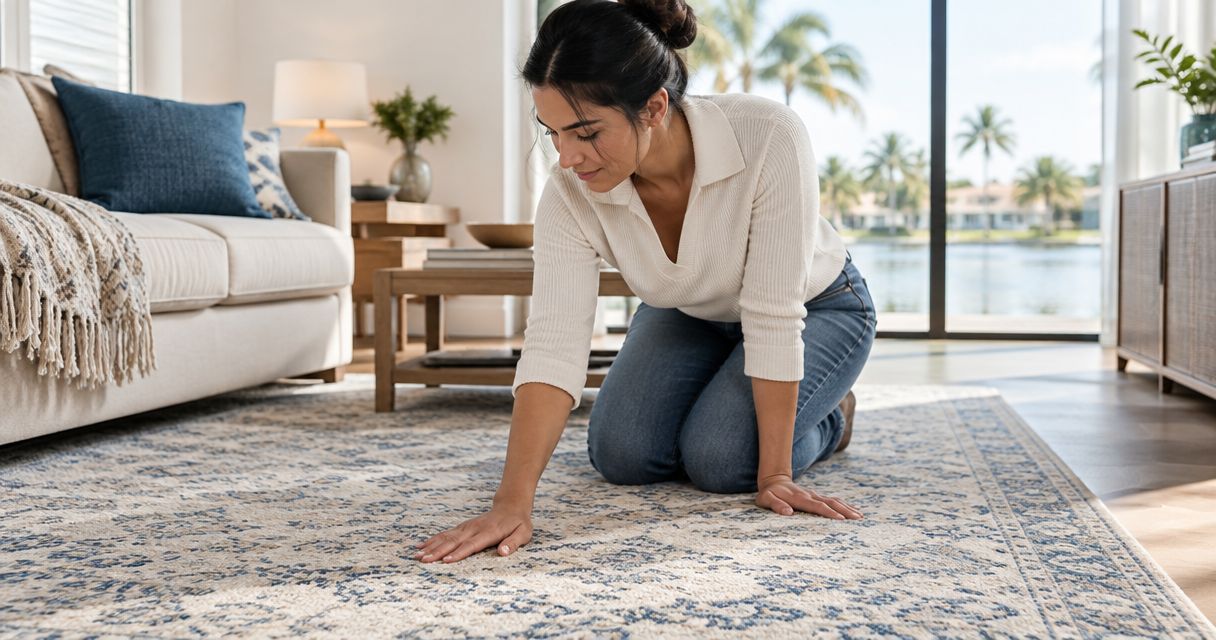
A rug inspection should consider fiber, dye stability, fringe, backing and construction. If the rug can be moved safely, inspection of its underside and the floor beneath it helps distinguish the rug from a separate odor source.
Do not assume a rug can receive the same moisture or agitation as the carpet around it. Ask what material checks support the proposed method and whether any part of the rug limits treatment.
What should the technician check on upholstery?
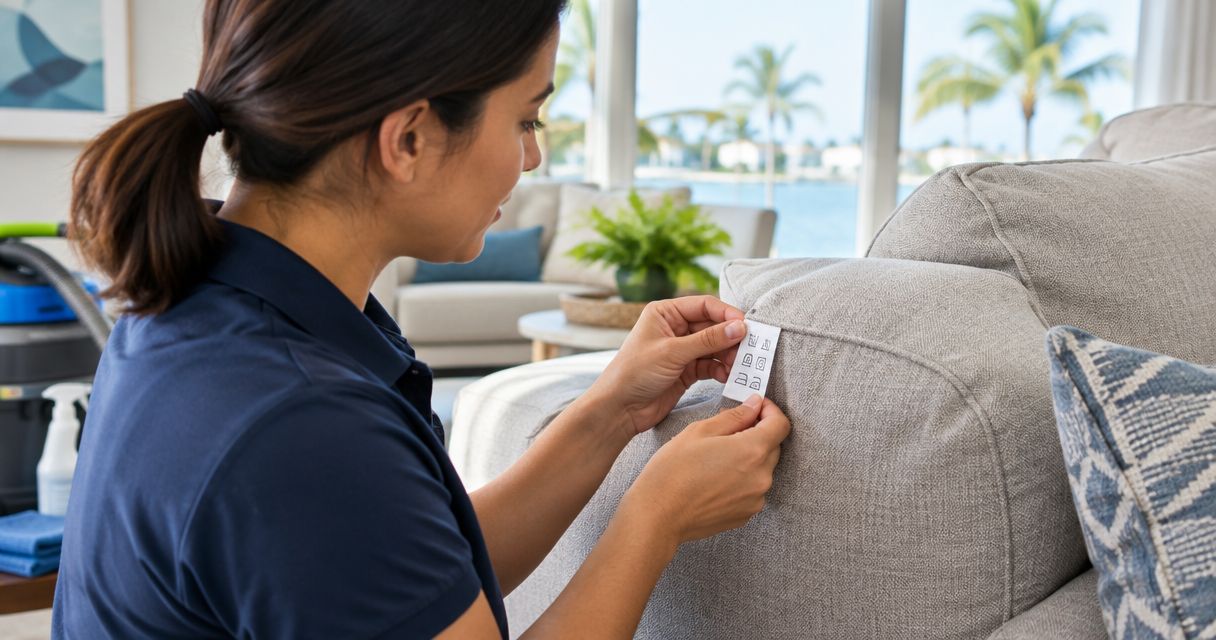
Upholstery inspection should include care information, fabric condition, seams and accessible cushion components. A removable cover does not necessarily mean the cover is washable, and clean-looking fabric does not establish that the filling is unaffected.
Ask whether the plan treats the fabric only or includes other accessible components. If contamination has entered internal filling, the estimate should acknowledge that limitation rather than describing the entire cushion as resolved.
What should the technician check on tile and grout?
Tile and grout inspection should distinguish surface residue from concerns involving joints, cracks, perimeter gaps or neighboring materials. Natural stone also needs material-specific consideration; a treatment suitable for ceramic tile is not automatically suitable for stone.
Dark grout is not proof of pet contamination. Likewise, lighter grout after cleaning is not proof of odor removal. Appearance and odor need separate assessments.
Contamination mapping: what detection can and cannot prove
The inspection should identify confirmed concerns separately from suspected ones. Useful observations include accident history, visible staining, localized odor, accessible underside inspection and relevant material tests. Each observation adds context; none should be treated as a substitute for the others.
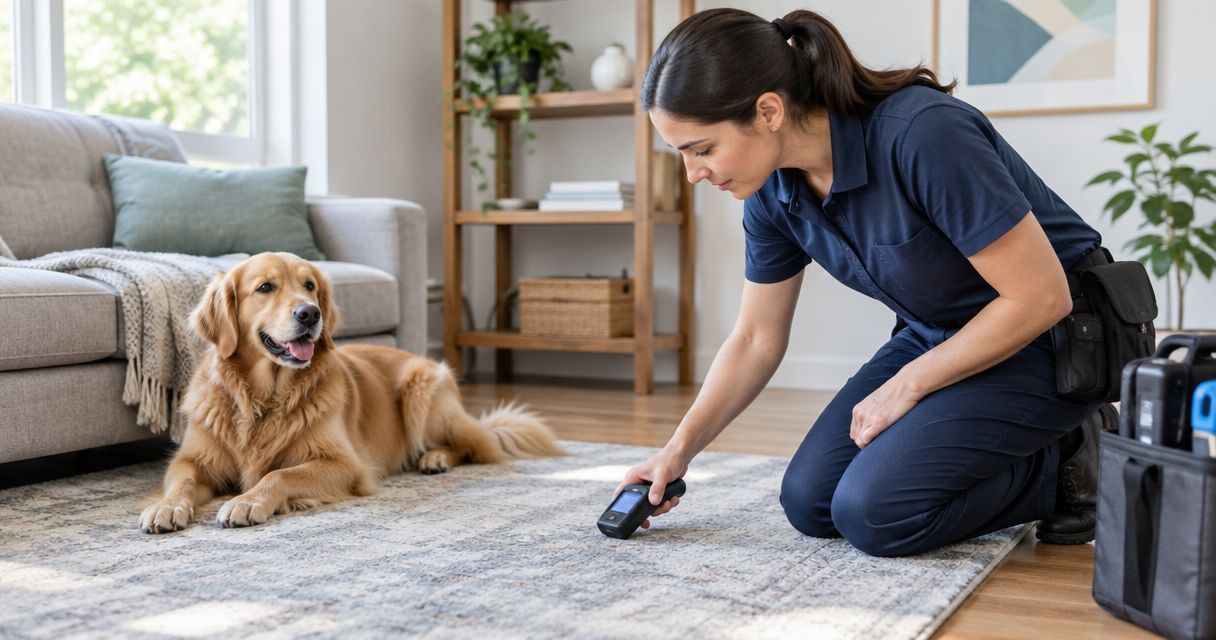
An ultraviolet light can help locate some residues, but fluorescence is not a definitive urine test. Other substances can fluoresce, and a lack of fluorescence does not rule out contamination. Ask how any highlighted area relates to the odor history and physical inspection.
Moisture readings also need interpretation. They describe conditions at the time of inspection, not a complete history of dry contamination. A dry reading alone does not establish that an old accident left no residue.
Detection should guide investigation, not become a sales demonstration. You should hear what the finding means, what it does not establish and whether further access is needed.
Why pet odor treatment varies
The same cleaning recommendation does not fit every odor problem. These factors change the treatment decision:
- Contamination depth: Surface residue presents a different access problem from affected backing, padding or cushion filling.
- Repeated accidents: Repeated contamination can involve a wider area or additional layers beyond the visible mark.
- Material suitability: Fiber, dye, backing, finishes and construction determine which treatments are appropriate.
- Previous treatment: Residues, fragrances and chemical exposure affect assessment and method selection.
- Access: Fixed furniture, attached upholstery and concealed layers limit what can be inspected or treated.
- Drying conditions: Moisture control and airflow matter when assessing the material after wet treatment.
Ask the technician to identify which factors apply to your home. A generic explanation of pet odor is less useful than a clear account of your affected material and the proposed scope.
What should your estimate say after the inspection?
For a pet odor removal service estimate in 2026, ask for the affected areas and intended treatment to be described clearly. General carpet cleaning and targeted pet contamination treatment should not be presented as interchangeable without explanation.
The estimate should identify the accessible material, the purpose of pre-treatment, any planned agitation and the cleaning method. It should also explain material-related restrictions and whether inspection left any hidden layers unconfirmed.
Ask how the result will be evaluated after drying. A fragrance immediately after cleaning is not evidence that the source has been removed. You need a practical way to report a remaining odor and distinguish it from a remaining visible stain.
Steamly Pro is best for local homeowners seeking carpet, upholstery, tile and area rug cleaning within its Florida service area. When requesting a free estimate, describe the odor concern explicitly rather than requesting general cleaning and assuming pet treatment is included.
Request a pet odor cleaning estimate
Describe the affected material, accident history and previous treatments when requesting your free estimate.
Can professional cleaning remove pet odor completely?
Professional cleaning can address pet odor when the source is accessible and the material supports the necessary treatment. No responsible cleaner can guarantee every odor outcome before understanding contamination depth, construction and previous treatment.
A persistent odor after surface cleaning calls for reassessment of the source and affected layers. It does not automatically justify repeating the same treatment or applying a stronger household chemical.
Does a visible urine stain show the full affected area?
A visible urine stain does not reliably show the full affected area. Liquid can spread differently through surface fibers, backing and absorbent underlying materials, so the inspection should not rely on the outline of the stain alone.
The opposite also applies: discoloration can remain after the odor source has been addressed. Ask for separate expectations for stain appearance and odor treatment.
Should carpet padding or upholstery filling be replaced?
Replacement is a material-specific decision, not an automatic requirement for every pet accident. Inspection should establish why a hidden layer is suspected, whether it is accessible and whether cleaning can reasonably address it.
If the cleaner recommends replacement or work outside the cleaning scope, ask which component needs attention and what evidence supports that recommendation. Do not treat a recommendation as authorization for unagreed additional work.
How to prepare for a pet odor inspection in 2026
Make the affected areas accessible and secure pets away from the inspection space. Remove small personal items, but do not lift heavy furniture or pull up carpet yourself. Tell the technician about anything that blocks access.
Prepare the following information:
- Locations of known accidents and suspected odor sources.
- Whether contamination repeated in the same area.
- Product names or packaging from previous treatments.
- Available rug labels and upholstery care information.
- Your main concern: odor, staining, general soil or a combination.
For an HOA residence or commercial property, explain access arrangements and occupied areas before the visit. Clear access helps inspection; it does not change the treatment limits of the material.
FAQ
What should I ask a pet odor removal service before booking?
Ask whether the inspection covers material suitability, contamination depth, previous treatments and hidden-layer concerns. Request separate expectations for odor removal and visible stain improvement.
Can a cleaner find every pet urine spot with a UV light?
A UV light cannot establish every pet urine location or confirm urine by fluorescence alone. Findings need to be checked against odor history, material condition and other inspection evidence.
Will steam cleaning fix urine in carpet padding?
Surface carpet cleaning does not establish that contaminated padding has been treated. Ask whether padding is suspected and whether the proposed work reaches that layer.
Should I deodorize the room before the inspection?
Do not add fragrance or another spot treatment immediately before the inspection. Give the technician the names of products already used so those treatments can inform the assessment.
Can pet odor remain even when the stain disappears?
Pet odor can remain after a visible stain improves if the source persists elsewhere or in underlying material. Odor and appearance require separate expectations and assessment.
Does Steamly Pro serve homeowners outside Boca Raton?
Steamly Pro serves homeowners, HOA communities and businesses across Palm Beach County, Broward County and Port St. Lucie, Florida. Its cleaning services include carpet, tile and grout, upholstery and area rugs.
What should a pet odor inspection include in 2026?
A pet odor inspection in 2026 should include odor history, material checks, contamination mapping, depth assessment and treatment scope. The recommendation should explain accessible treatment and any unresolved hidden-layer concerns.
One last thing
Before accepting a cleaning recommendation in 2026, ask: Which affected layers does this treatment reach? That question separates an explained treatment scope from a promise based only on the visible surface.
Keep the answer with your estimate. If odor remains after drying, it gives you a specific starting point for reassessment rather than another round of trial-and-error deodorizing.